
What Bonneville County Deed Records Convey
Instruments presented for recording are indexed by the Bonneville County Clerk, Auditor and Recorder. Each deed names the grantor and grantee. It also carries a recording date and reference. It normally includes a legal description of the land. The instrument type matters. Different documents transfer different interests or grow out of different proceedings.
| Deed Type | What It Does | Common Use |
|---|---|---|
| Warranty deed | Conveys the stated interest with title covenants | Ordinary purchase and sale |
| Quitclaim deed | Conveys whatever interest the grantor has | Family, estate, or title cleanup |
| Trustee or personal-representative deed | Conveys through a trust or estate representative | Trust administration or probate |
| Sheriff's deed | Records a court-directed transfer | Execution or foreclosure sale |
| Tax deed | Records a county tax-deed transfer | Delinquent-tax proceeding |
Not everything filed beside a deed conveys ownership. Mortgages, deeds of trust, liens, releases, reconveyances, plats, and surveys all appear in the recorder's material. Read the instrument type before treating an index hit as a conveyance. A release clears one encumbrance, while a lis pendens merely announces litigation.
Open Bonneville County's 1911–Current Deed Index
Bonneville County's official deed index runs through the Tyler Self-Service Document Search, covering instruments recorded from January 1, 1911 forward. The index accepts several independent search keys. An address search that returns nothing is not the end of the road.
| Index key | Best use | Local caution |
|---|---|---|
| Grantor / grantee | Find transfers by party name | Try entity, trust, estate, and representative variants |
| Instrument number | Open a known recording directly | Preserve punctuation and leading zeros shown in the source |
| Book / page | Retrieve an older cited document | Especially useful for records before 1995 |
| Parcel or legal description | Cross-check a known tract | Older descriptions may use a prior subdivision name |
| Recording date | Narrow a recent transaction | Do not rely on date searching for pre-1995 records |
The recorder's search page displays the official entry point and its available search paths. Open the live Tyler index to run your own Bonneville County deed search rather than relying on the pictured interface.
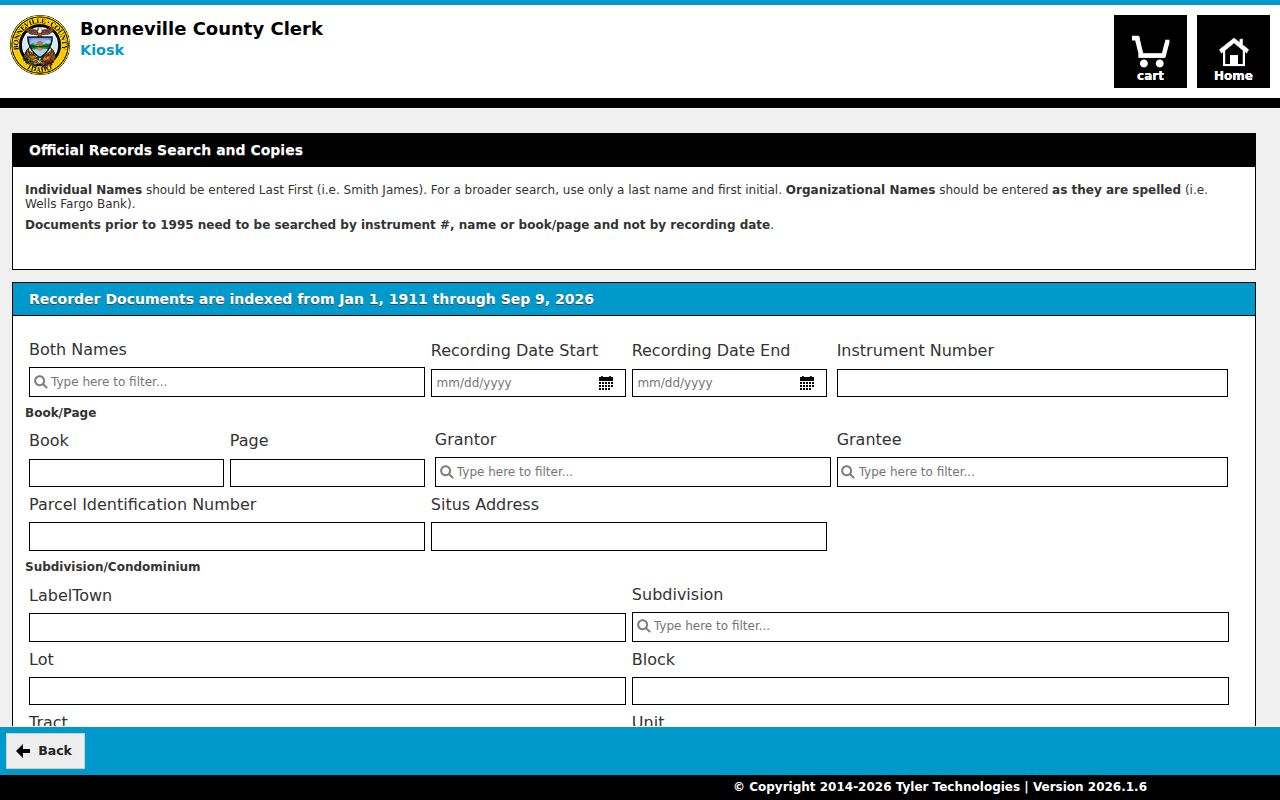
The image is only a navigation aid. The live index controls, its coverage notice, and the results it returns remain authoritative.
Note: The stated end date marks online coverage, not a promise that every instrument has been imaged.
Why Pre-1995 Bonneville Deed Searches Need Different Keys
Records before 1995 work differently. The recorder's notice directs searchers to instrument number, party name, or book and page. Recording date is not one of the keys. Start with the prior recording reference on the current deed. If that reference points to a book and page, carry it intact into the older search. Replatted subdivisions call for both the current name and the older one in the legal description.
This is an important local distinction. The online index reaches well back of 1995. But the search control that works best changes. A narrow date window alone can produce a false no-result. So lean on the reference numbers the deeds themselves supply.
Walk the Bonneville Grantor-Grantee Chain
A chain-of-title search follows people or entities through successive Bonneville County deed records. Start at the present end. Then work backward one verified conveyance at a time.
- Use the Parcel Viewer owner field and instrument reference as discovery clues, then find the present owner's acquisition deed with that owner as grantee.
- Read the grantor, legal description, deed type, recording date, and instrument or book/page reference from the actual image.
- Search that grantor as an earlier grantee, checking name variants and matching the same legal description.
- Repeat until the chain reaches the 1911 online boundary, then use recorder books, FamilySearch images, and archival aids.
- Grantor
- The party conveying the stated interest.
- Grantee
- The party receiving the stated interest.
- Chain of title
- The linked sequence of recorded conveyances affecting the same land.
- Book/page and instrument number
- Two recording references used to identify a specific Bonneville document.
Use PIN, Situs, and Subdivision as Cross-Keys
The Bonneville County Parcel Viewer shows the PIN, situs address, subdivision, legal description, tax-roll owner in one place. It also shows a recorder instrument reference. These fields help separate same-name parties. They also help locate a deed when a street address has changed. A sample PIN like RPA0820001004C reflects the county's alphanumeric style. The county publishes no decoding legend for it.
Always carry the legal description into deed research, not just the street address. Lots get split, combined, amended, or replatted, and addresses get renumbered. Idaho Falls records such as the Hodson Addition amendments and the Houston Heights replat show why both current and former subdivision labels can matter. Keep this in mind when you trace an older parcel.
When a PIN changes, start with the newest deed. Follow its references back to the parent parcel or an earlier plat. Match acreage, lot and block, subdivision, and distinctive description clauses. Do this before attaching an older instrument to the current land. A street address is a useful clue. The recorded description is the stronger continuity check.
Note that large-format plat or survey copies carry a separate county fee. The mapped tax line still does not establish a surveyed legal boundary. So a deed-chain question and a boundary-location question may call for different professional review.
Read Liens, Releases, and Reconveyances Beside the Deed
A purchase deed is just one item in a property's recording trail. Search the same parties and legal description. You will find deeds of trust, mortgages, assignments, releases, reconveyances, judgments, and lis pendens. Match each release to the obligation it references. Never assume one release clears every lien.
Property litigation is indexed separately through Idaho iCourt. Check the deed index afterward for a recorded notice, judgment, sheriff's deed, or later release. A court docket and a land record answer different questions.
Recorded does not mean adjudicated. An index entry shows that a document entered the public recording system; it does not establish priority, validity, or clear title.
Extend a Bonneville Deed Chain Beyond Tyler
When the online chain ends, the recorder counter is the first official route. The older deed books remain the first route too. The FamilySearch Bonneville County Records collection holds 123,122 images with date coverage described as 1867–2012. It is an image collection, not a complete name index. Book and page references matter most there.
The Idaho State Archives offers historical county records, maps, documents, catalogs, and research services. Idaho Falls directory runs can add occupant or business context. A directory entry is not a conveyance, though. Use historical sources to bridge names and dates. Then return to the deed books for the ownership trail.
At each step, copy the cited prior instrument, full party names, deed type, and unchanged legal-description phrases. Treat a name from a directory or probate file as a lead. Verify the actual conveyance in the recorder material. The county has no record of a courthouse fire or a destroyed decade of deeds. An apparent gap calls for book, image, and counter work rather than an assumed records loss.
Order a Bonneville County Deed Copy
Deed copies in Bonneville County come from the Clerk, Auditor and Recorder. The office offers online images when available. It also takes requests by mail or at the counter. Fees are simple. Plain copies run $1 per page. Certification adds $1 per document, and large plats or surveys cost $5 each. Confirm the current amount before you order. Have the instrument number or book and page ready, so the recorder can find the deed records quickly.
For research in person, visit the recorder at 605 N. Capital Ave. in Idaho Falls. A mail request works best when it is precise. List the parties, the instrument number, the recording date, the document type, and the legal description or PIN. Say whether you need a certified copy, and include a return address. If the portal shows no image for a parcel, ask at the counter whether the document can still be pulled. Don't assume it was never recorded.
Recorded, not guaranteed. Bonneville County describes its online index as a catalog-like guide and does not certify authenticity there. A recorded copy is not a title opinion, and unrecorded interests may exist.
Monitor New Bonneville Instruments Without a Fraud-Alert Claim
Bonneville County publishes no official property-fraud-alert signup page. The practical official route is periodic checking of the recorder index. Search by owner, parcel, and legal description. Search each key, and inspect unfamiliar instruments. Contact the Recorder through the county office page when something looks off.
Save the newest instrument number you know. Save the exact indexed owner of record, the PIN, the subdivision, and the legal-description phrase. On each later check, search those keys and compare recording dates and document types. Open any unfamiliar entry. Match its land description before treating it as affecting the parcel. A same-name party or a nearby parcel can otherwise cause a false alarm.
Watch releases and reconveyances too, not just deeds. A new lien, assignment, release, plat, or court-related notice can change the recorded trail. It can do so without transferring ownership at all. When an index description is unclear, contact the Recorder and request the document by its recording reference. Do the same when an image is missing.
Portal features change over time. Ask the Recorder whether an official alert service has launched. Until then, periodic index checks remain the documented official-data route for Bonneville County property records.
Note: Ask the Recorder whether a local alert option for deed records has launched before relying on any third-party substitute.
Log the date of each repeat search. That habit lets you tell a truly new instrument apart from an older result you simply overlooked in the Bonneville County deed index.